The Complete Paragliding Guide for First-Time Flyers: From Booking to Landing
Your first tandem paragliding flight should begin with good questions, a proper briefing and a pilot who is willing to wait for the right conditions. This detailed India-focused guide explains how to choose an operator, what the equipment does, what to wear, how launch and landing work, and which red flags should make you walk away.
A few steps.
A whole new view.
Get a feel for the journey. Drag through the stages, then discover what to expect.
Explore the flight chapterIt starts with a few steps.
THE FIRST-FLIGHT FIELD GUIDE
Start here
Your first flight starts on the ground.
The first surprise about tandem paragliding is that it does not begin with a leap.
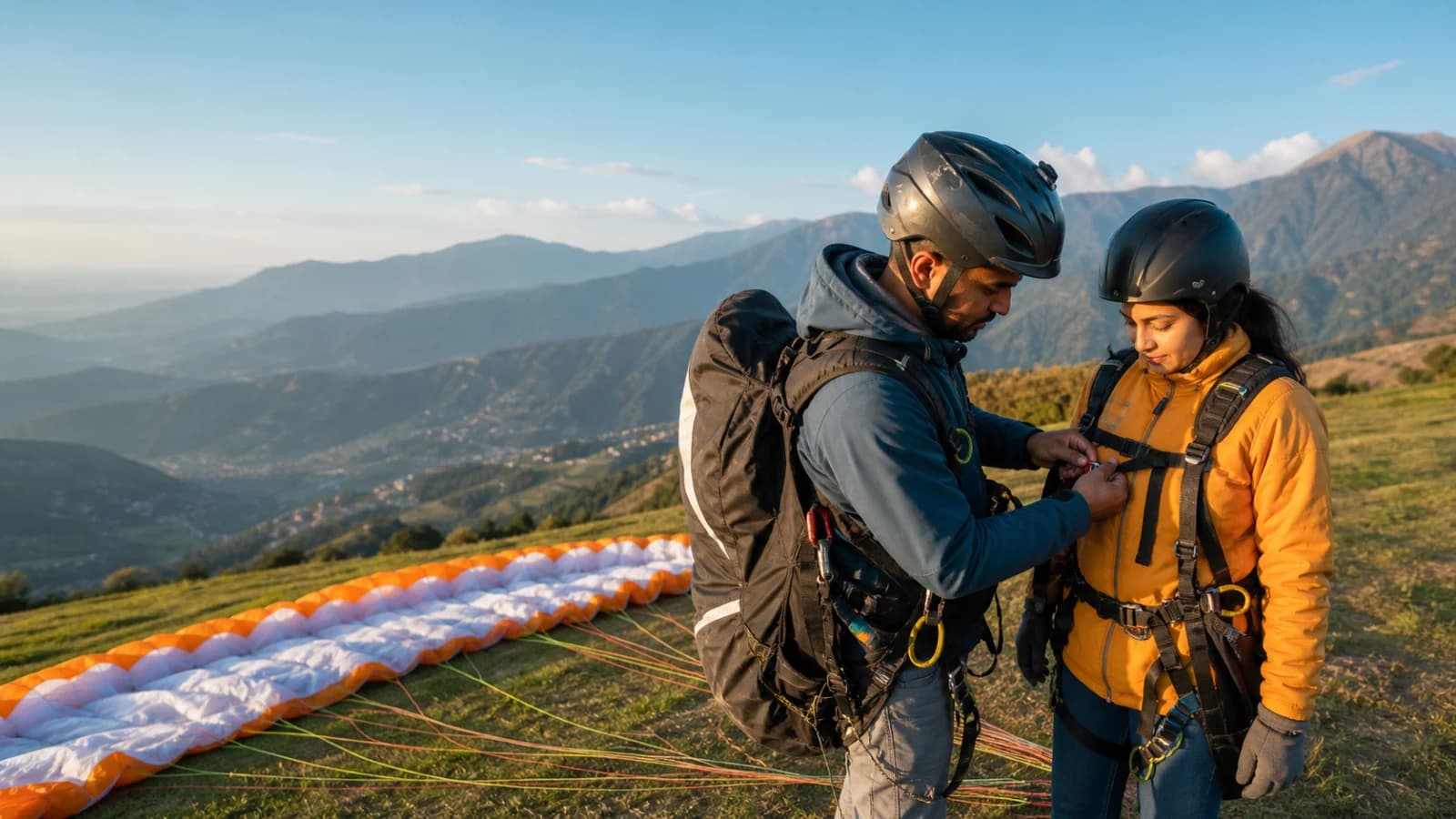
It begins on the ground: checking the weather, laying out the wing, untangling lines, fitting two harnesses, connecting the pilot and passenger, and rehearsing exactly what both people will do during launch and landing. If that preparation is calm and methodical, the flight itself can feel remarkably simple.
This guide is for someone booking a first tandem flight in India. You do not need to know how to pilot the glider. You do need to choose a responsible operation, disclose anything that affects your ability to participate, listen carefully and be willing to wait—or not fly—when conditions are unsuitable.
The safest-looking flight is often the one that gets delayed or cancelled. A professional pilot protects the decision, not the schedule.
The 60-second checklist
Before you pay or travel to launch, ask these questions:
Clear answers are a good sign. Pressure, ridicule or vague promises are not.
What tandem paragliding actually is
A paraglider is a foot-launched glider. Its wing has no rigid frame; its airfoil shape forms when air enters the cells along the leading edge. Suspension lines connect the wing to risers, which connect to the tandem system and harnesses.
On a tandem flight, a qualified pilot controls the glider while the passenger sits in a separate harness in front. The two harnesses are connected through tandem spreaders. Launch normally involves both people moving forward together until the inflated wing produces enough lift. Landing normally involves approaching an open landing area, becoming upright and following the pilot's instruction to run, keep legs raised, or use another technique suited to the conditions and equipment.
A tandem discovery flight is not the same as learning to fly solo. If you want to become a pilot, choose a structured course with ground handling, theory, supervised flights, logged tasks and formal assessment. A scenic tandem flight can introduce the sensation of free flight, but it does not grant a pilot rating.
THE FIRST-FLIGHT FIELD GUIDE
Before you book
Good questions. Better decisions.
Choosing an operator: look beyond price and flight duration
Low price and a promised number of minutes tell you very little about safety. Weather, launch traffic and usable lift can change the duration of an unpowered flight. A responsible operator should not promise an exact airtime regardless of conditions.
1. Confirm that the operation is authorised
Rules vary by state and site. In Himachal Pradesh, official travel-safety guidance tells visitors to use government-authorised agencies and registered adventure guides. Bir-Billing also operates under state rules and local procedures; the same paperwork cannot simply be assumed to cover another state or launch.
Ask for the operator's current local registration or authorisation. If a pilot is working through a company, confirm that both the business and the pilot are eligible for the commercial flight being sold.
2. Ask who is actually flying
A business name is not a pilot credential. Ask for the name of the tandem pilot assigned to you and request to see the relevant current rating or endorsement. A solo proficiency card, competition result or long list of flights is not automatically a tandem-commercial privilege.
You can also ask:
- How recently has the pilot been flying at this site?
- Who makes the final weather decision?
- Does the pilot carry a radio or another agreed communication system?
- What is the operation's response plan if a flight lands away from the usual field?
Professional pilots usually answer specific questions specifically.
3. Look for a safety system, not one impressive object
A new-looking wing does not compensate for a poorly fitted harness. A reserve does not compensate for rushing the connection check. Safety comes from the whole system: competent people, suitable conditions, maintained equipment, correct loading, passenger briefing, site management and an emergency plan.
The Ministry of Tourism's adventure-tourism guidance calls for pilot and equipment records, passenger briefing, certified equipment, insurance documentation, an emergency action plan, first-aid capability and regular inspection for commercial operations. Treat those as useful questions to ask, not as decoration for a website.
Before booking: eligibility, health and honest disclosure
There is no universal passenger age, height or weight rule that applies to every tandem wing, harness, operator and site. Each system has a certified loading range, and operators may set narrower limits because of conditions, launch geometry or local rules.
Ask for the operator's actual limits before paying, and give an accurate weight including the clothes and shoes you will wear.
You should tell the operator in advance if any of the following may affect you:
- Pregnancy
- A heart, breathing, neurological or balance condition
- A recent operation, fracture or significant injury
- A neck, back, hip, knee or ankle problem
- Limited ability to run several committed steps or absorb a landing
- Fainting, seizure or severe motion-sickness history
- Medication that causes drowsiness, impaired judgement or poor coordination
- Any condition your clinician has advised may be incompatible with adventure sport
This is not a diagnosis list. It is a disclosure checklist. The operator can explain the physical demands, but only an appropriate medical professional can advise you about your health. When unsure, pause the booking and ask your clinician.
Do not fly while impaired by alcohol, recreational drugs or sedating medication. Do not hide an injury because you have already travelled to the site.
Insurance: read the exclusion, not just the heading
“Travel insurance included” can mean many things. Confirm whether the policy covers paragliding, whether it applies to a tandem passenger, what medical and evacuation limits apply, which hospitals or regions are covered, and who initiates a claim.
If you rely on your own travel or health policy, check whether it excludes adventure sports, aerial activities or flights above a stated altitude. Save the policy and emergency contact details offline. A waiver acknowledges risk; it is not an insurance policy and does not prove that the operator is competent.
THE FIRST-FLIGHT FIELD GUIDE
Get ready
Get to know the kit. And your part in it.
What to wear and carry
Dress for the launch altitude and wind, not the temperature in the town below.
Wear
- Closed shoes with secure laces and a grippy sole
- Full-length, flexible trousers that let you run freely
- Layers that can block wind: a light insulated layer and wind-resistant outer layer are often useful
- Gloves in cold conditions if the operator recommends them
- A securely fitted helmet supplied or approved by the operator
Avoid
- Sandals, flip-flops, loose scarves or dangling jewellery
- A bulky backpack unless it is specifically integrated or secured by the operator
- Anything in an open pocket that can fall onto people or property below
- Holding a phone, action camera or selfie stick during launch or landing
Tie back long hair. Empty unsecured pockets. If photography is offered, ask how the camera is mounted and whether it changes what you must do. Your hands and attention should be available for the briefing.
Bring water, sun protection and any essential medication for the time spent waiting on the ground. Leave valuable loose items with a non-flying companion or in secure storage.
The tandem equipment system, explained
A closer look. From every angle.
An original detailed model · 4.8 MB
Meet the complete setup.
Choose a part below to highlight it and move into a close-up. You can also tap the model itself, rotate it freely, and explore at your own pace.
Pilot and passenger are shown seated. Use the people control to inspect the harnesses on their own. Illustrative setup; equipment and attachment arrangements vary.
Original equipment photo & reference
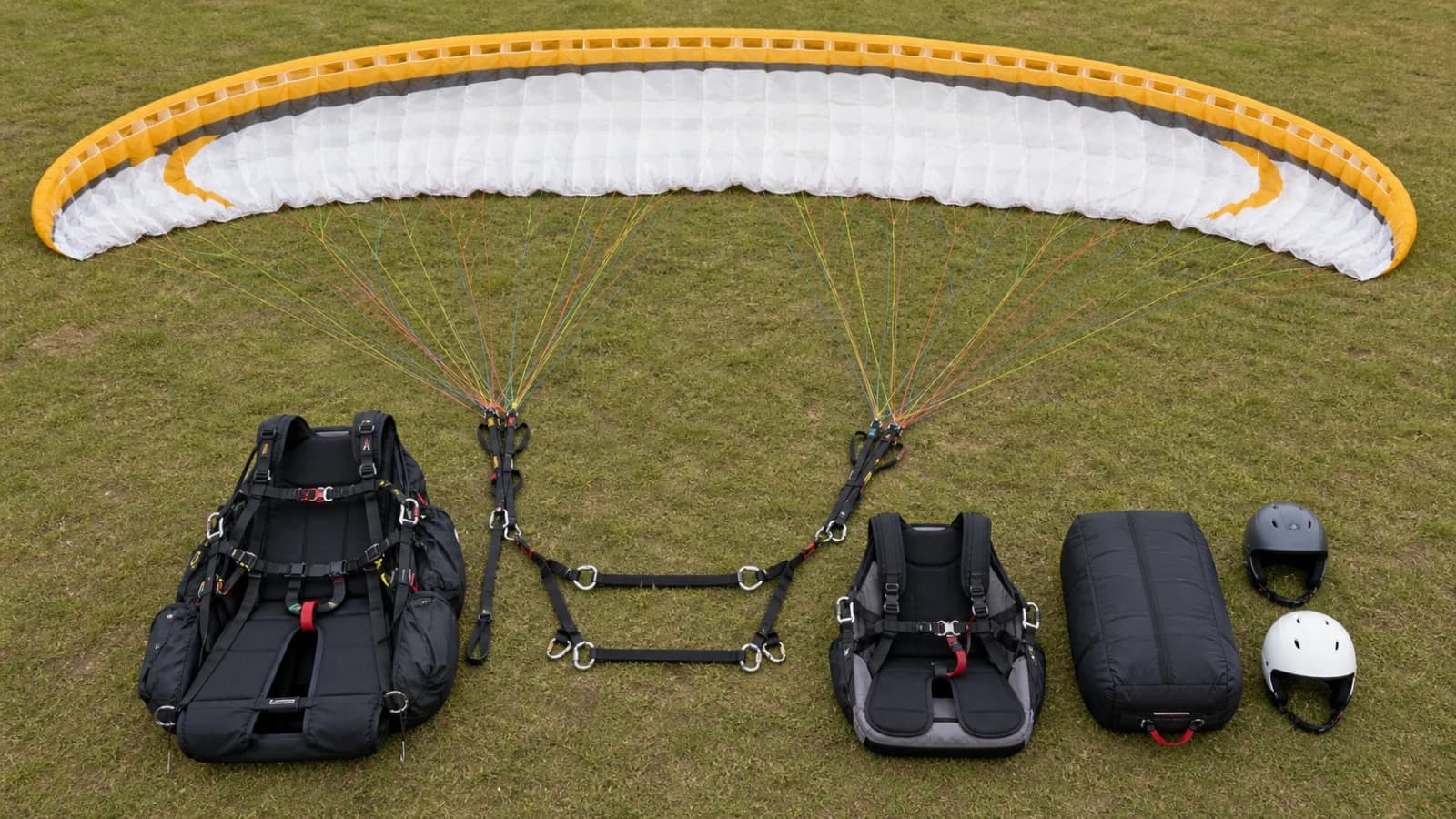
The equipment works as one connected system. The photograph is an orientation image, not a substitute for a pilot's physical inspection or the manufacturer's manual.
Wing
The fabric canopy creates lift. Commercial tandem wings are designed for two-person loading, but the exact certified weight range depends on the model and size. The pilot should know the combined in-flight weight and whether it fits the equipment and conditions.
Lines and risers
Thin suspension lines distribute load between the wing and the risers. They must be correctly routed, free of knots and clear of sticks, stones and snags. Passengers should not rearrange them or step through them unless directed.
Tandem spreaders and connectors
Spreaders establish the relationship between pilot, passenger and wing. Connectors must be compatible, correctly oriented and secured. This is one reason the final connection check should be deliberate and interruption-free.
Pilot and passenger harnesses
The harnesses support both occupants. Depending on the design, they can include leg and chest straps, seat structure and impact protection. Fit matters: a buckle that exists but is not correctly routed or secured does not do its job.
Reserve parachute
The reserve is an emergency system, not a second main wing. Its size, installation, repack history and compatibility with the tandem load matter. A visible handle alone does not prove that the reserve is suitable or in service.
Helmets and communication
Each occupant should have a properly fitting helmet appropriate to the activity. Pilots may also use radio communication with ground staff or other pilots. A passenger should still receive a direct verbal briefing; a radio is not a replacement for one.
What should happen before launch
1. The pilot assesses the site and conditions
Wind direction and strength are only part of the picture. Pilots also consider gusts, cycles, cloud development, visibility, precipitation, terrain effects, turbulence, launch traffic, landing conditions and how conditions are changing.
Passengers should not be expected to make this technical judgement. Your useful question is: “What would make you cancel this flight today?” A pilot who can describe a limit—and respects it—is more reassuring than someone who says conditions are “always fine.”
2. The equipment is laid out and checked
The wing should be positioned for the launch, the lines sorted, the risers identified and the harness system checked. The pilot should inspect the connections after both people are fitted. Avoid distracting the pilot during this phase.
3. You receive a real briefing
At minimum, you should understand:
- Where to stand and where the pilot will be
- When to walk and when to run
- Why you must keep moving until told otherwise
- Where to put your hands
- What to do if the pilot aborts the launch
- When and how to settle into the harness after take-off
- What signals or words the pilot will use before landing
- Whether you should run, keep your legs raised or follow another landing instruction
Ask the pilot to repeat anything unclear. “Just run” is not a complete first-time briefing.
THE FIRST-FLIGHT FIELD GUIDE
Your flight
From the first steps to feet on the ground.
Launch, flight and landing: your job as the passenger
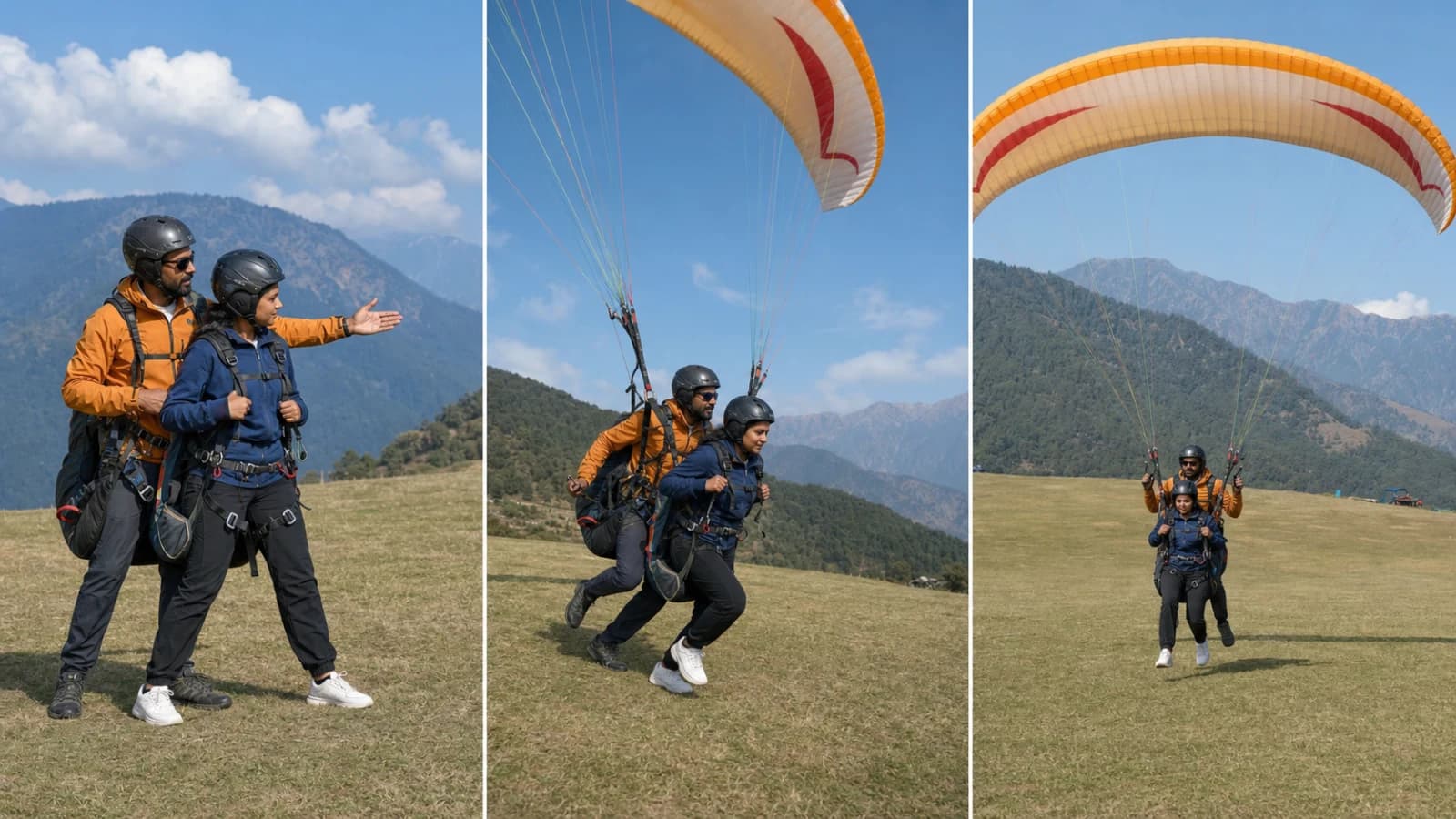
Your exact technique must come from your pilot at the site. The sequence above shows the central idea: listen, move together and stay ready to use your legs.
During launch
The wing is normally inflated behind or above you. You may feel resistance change as it rises. Keep your torso facing the instructed direction and move with commitment when the pilot calls.
Do not stop because the wing tugs backward. Do not sit into the harness early. Do not jump from the slope. Continue walking or running until the pilot says otherwise or your feet naturally leave the ground.
If the pilot aborts, stop only as instructed and be ready for the wing to settle. An aborted inflation is a normal safety action, not a failed adventure.
In the air
Once clear of the terrain, the pilot may tell you when to settle back into the passenger harness. Keep your movements smooth. Tell the pilot immediately if you feel unwell, a strap feels wrong, or you want a calmer flight.
Turns create bank and can increase motion sensation. Aerobatic manoeuvres should never be assumed. India's adventure-tourism guidance says no aerobatic manoeuvres should be performed with clients. If an operator sells “extreme” manoeuvres, ask exactly what is proposed and do not be pressured into accepting it.
Looking at the horizon, breathing normally and avoiding rapid head movements may help some people with motion discomfort, but tell the pilot early rather than trying to endure worsening nausea.
Before landing
The pilot should brief you again. Become upright when instructed and prepare your legs. Do not invent your own landing technique based on a video: wind, speed, terrain and harness design affect the plan.
If told to run, keep running after the first foot contact until the pilot says stop. If told to keep your legs raised for a planned seated or sliding landing, follow that instruction. The essential rule is to listen to the pilot assigned to your flight, not to conflicting advice shouted from spectators.
Weather delays and cancellations are part of paragliding
Paragliders are light aircraft flying in a changing atmosphere. A blue sky does not guarantee suitable conditions, and clouds do not automatically mean a flight is impossible. The decision is about the complete local weather picture.
Expect any of these outcomes:
- Waiting for a better wind cycle
- Moving to a different launch used by the authorised operation
- Shortening the planned flight
- Returning without launching
- Rescheduling to another day
- Cancelling because launch or landing conditions are outside limits
Agree on the commercial policy before you travel uphill. Safety decisions should not become arguments about money at the launch.
THE FIRST-FLIGHT FIELD GUIDE
Making decisions
Know when to go. Know when to wait.
Red flags: when to step away
Do not fly if you see a combination of pressure and poor process. Specific warning signs include:
- The operator refuses to identify the pilot or show relevant credentials
- Nobody asks your weight or whether you can perform the launch and landing actions
- A helmet or passenger harness is unavailable, obviously damaged or poorly fitted
- Connections are made in a rush while several people interrupt the pilot
- You receive no explanation of launch, abort and landing actions
- The pilot mocks your questions or tells you to hide a medical issue
- Staff promise a fixed flight duration regardless of weather
- Passengers are launched while pilots nearby are repeatedly aborting or discussing worsening conditions
- You are encouraged to hold a phone or selfie stick during the launch run
- The pilot appears impaired, exhausted or unusually agitated
- You are told cancellation is impossible because you have already paid
Walking away can be disappointing. It is still the right decision when trust has broken down.
A note for Bir-Billing flyers
Bir-Billing combines a mountain launch near Billing with a landing area around Bir. It can also become busy, particularly in popular seasons. Treat transport to launch, queue management, launch marshals, the assigned pilot and the landing plan as parts of one operation—not as unrelated services.
Ask where you will meet, who transports you, where personal items remain, who confirms the pilot assignment and what happens if the team reaches launch but does not fly. Follow current instructions from authorised local staff and site officials.
Himachal Tourism advises visitors to use government-authorised adventure agencies and registered guides. Local rules and operational status can change, so re-check them close to your flight date.
Tandem flight or pilot course: which should you book?
Choose a tandem discovery flight if you want to experience free flight with a pilot responsible for control.
Choose a beginner course if you want to understand the wing, practise ground handling, learn theory and progress toward supervised solo flight. A proper course takes more time and depends heavily on weather and demonstrated competence.
Do not choose a course simply because it promises the fastest rating. Do not choose a tandem flight advertised as “training” unless the learning objectives, instructor role and progression are clear.
For the rating pathway, read GoLeap's companion guide: Paragliding Licences in India, Decoded: P1–P5, APPI and IPPI.
For equipment inspection and lifespan, read: Paragliding Equipment Care: Inspection, Testing and When to Retire Gear.
THE FIRST-FLIGHT FIELD GUIDE
Questions & next steps
A little more clarity before you take off.
Frequently asked questions
Do I have to jump from a mountain?
No. A normal foot launch involves moving down a suitable launch slope with the pilot while the wing inflates and begins producing lift. You should not be asked to jump from a cliff.
What if I am afraid of heights?
Tell the operator before booking and the pilot before launch. Some people find a gradual foot launch different from standing at an exposed edge, but nobody can guarantee how you will feel. You can withdraw before launch.
Can I take my phone?
Only if the operator has an approved way to secure it and the pilot permits its use. Never let filming interfere with the launch or landing briefing. A mounted camera operated by the pilot or operator is generally less distracting than a loose phone.
Can children or older adults fly?
Age alone does not answer the question. Local rules, operator policy, equipment loading, the person's ability to understand instructions and perform the required movements, guardian consent, and health all matter. Ask the authorised operator for the current site-specific rule.
Is a longer flight always better?
No. Duration depends on height, air movement, route and safety decisions. A shorter, well-managed flight in suitable conditions is better than stretching airtime to meet a marketing promise.
What if conditions change after take-off?
Pilots continually assess the flight and can choose a direct landing. Follow instructions and avoid sudden movements. Landing early can be a prudent decision.
Is paragliding safe?
Paragliding is an adventure air sport with real risk. Competent pilots, maintained equipment, suitable conditions, correct loading, proper briefing and regulated operations can reduce risk; they cannot eliminate it. Anyone promising “100% safe” is making a claim no outdoor aviation activity can support.
The best first flight is a well-managed one
Your first paragliding memory should not be defined by how high you went or how many minutes you stayed airborne. It should be defined by a team that answered questions, checked the complete system, fitted the equipment carefully, briefed you clearly, waited for suitable conditions and treated cancellation as a legitimate outcome.
You are not expected to inspect like a pilot. You are allowed to expect the pilot to behave like one.
Official references and further reading
- Indian Adventure Tourism Guidelines, Version 2.0 — Ministry of Tourism, Government of India
- Travel Safety Tips — Himachal Pradesh Tourism
- Department of Tourism & Civil Aviation, including H.P. Aero Sports Rules, 2022 — Himachal Pradesh Tourism
- Paragliding Safety — FAI/CIVL
- Information for Tandem Students — USHPA (United States context; useful for questions about briefing, waivers and insurance, not a statement of Indian law.)
Last fact-checked: 19 August 2026. Regulations, local operating status and site procedures can change; verify them with the relevant authority and operator before flying.