
GOLEAP FIELD NOTES
Paragliding Licences in India, Decoded: P1–P5, APPI, IPPI and the Safety Questions That Matter
P1, P2, P3, APPI and IPPI are often discussed as if they are competing licences. They are not. Here is a plain-English guide to India's paragliding ratings, who governs what, which level fits your flying goals, and what passengers should verify before take-off.

- paragliding
- paragliding safety
- pilot licences
- APPI
- IPPI
- India
Ask five pilots what a “paragliding licence” means in India and you may hear five versions of the same alphabet soup: P1, P2, P3, APPI, IPPI, FAI, ACI.
The confusion is understandable. Paragliding in India sits inside a layered system. One organisation may assess your skills, another may translate that rating internationally, and a state or site authority may decide whether you can fly at a particular place. A card that proves proficiency is not automatically a permit to launch anywhere you like.
Here is the simplest way to think about it:
A rating proves a level of training. A tandem endorsement proves a separate privilege. A site permission allows a particular operation. You may need all three—but they are not the same thing.
The short answer: P-levels, APPI and IPPI
| Term | What it is | What it is not |
|---|---|---|
| P1–P5 | A staged pilot-proficiency pathway used by the Paragliding Association of India (PAI) and many Indian schools | A promise that every site will let you fly |
| APPI 1–5 | An international training and certification system run by the Swiss non-profit Association of Paragliding Pilots and Instructors | A blanket legal permission in every country |
| IPPI 1–5 | The FAI/CIVL international proficiency reference that helps a foreign site compare your national rating | A training course, insurance policy, or standalone international flying licence |
The numbers roughly line up by level, but the issuing system's current syllabus and assessment always control. Do not self-convert one card into another.
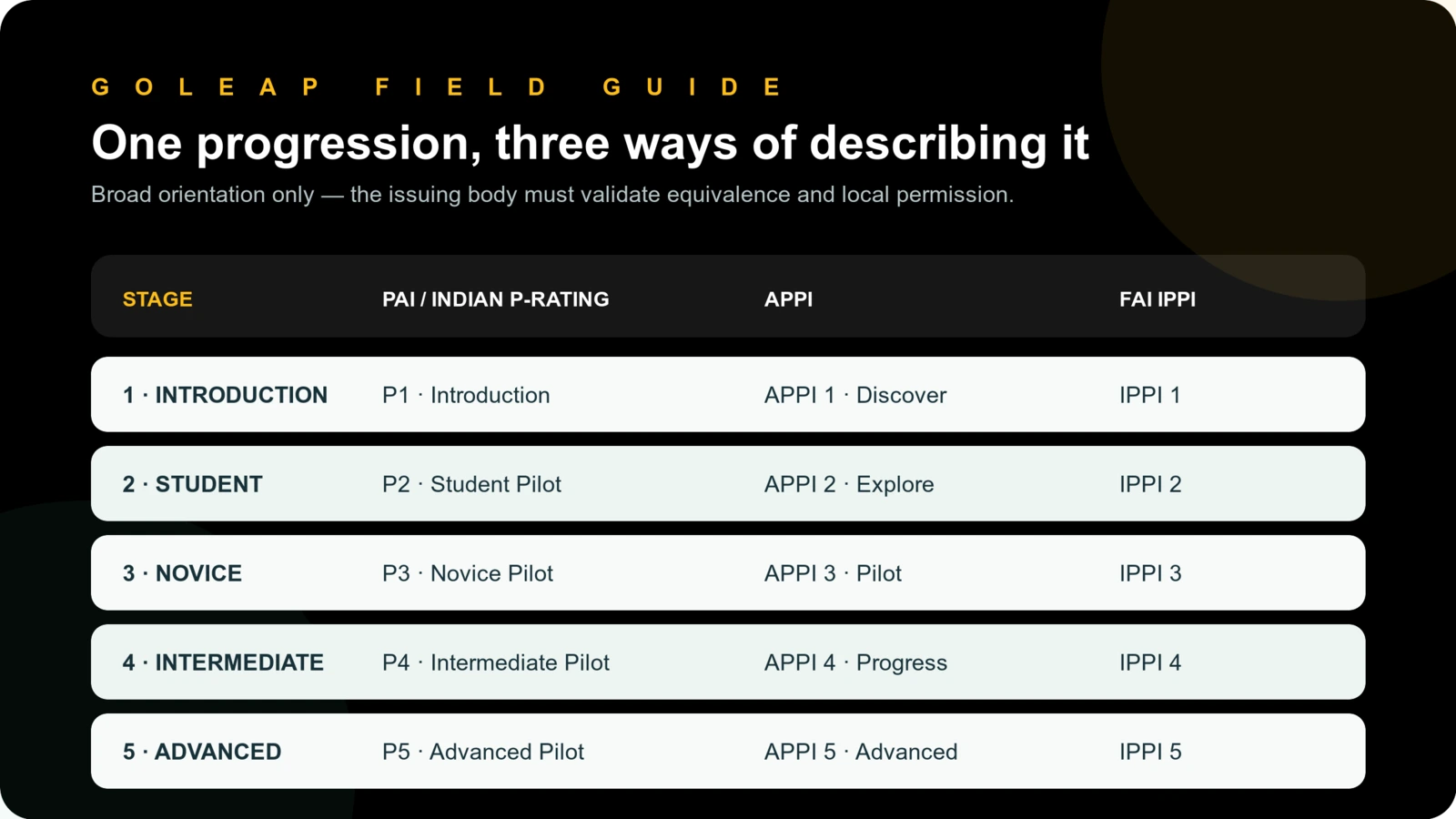
The chart is an orientation guide, not an automatic equivalence or site permission. The issuer must validate any conversion.
Who actually governs paragliding in India?
There is no useful single-word answer. The system has national, sport, state and site layers.
1. Ministry of Civil Aviation and the national air-sports framework
The Ministry of Civil Aviation's National Air Sports Guidelines 2023 include paragliding. They place the Aero Club of India—India's National Airsport Control, or NAC—at the centre of the governance structure, accountable to the Air Sports Federation of India under the Ministry.
The guidelines give the Aero Club of India a role across regulation, certification, competitions, awards and penalties, working through national air-sport commissions. They also require people and entities engaged in air sports to register with the appropriate commission and require airspace coordination where applicable.
2. Aero Club of India and the paragliding commission
The Aero Club of India (ACI) is India's member organisation in the Fédération Aéronautique Internationale (FAI). FAI's current India listing identifies ACI and its hang-gliding and paragliding representation. Its India IPPI page also says IPPI cards are accepted in India, subject to the national and local requirements that remain in force.
3. State governments, district committees and site authorities
This is the layer pilots and passengers meet on the ground. A state can regulate operators, pilots, equipment, seasons, take-off and landing sites, insurance, local registration and inspections.
Himachal Pradesh is a clear example. Its Department of Tourism and Civil Aviation lists the H.P. Aero Sports Rules, 2022, and the Ministry of Tourism has stated that district technical committees enforce their protocols and perform inspections. Those rules include separate requirements for commercial tandem pilots and technical checks of equipment.
Rules at Bir-Billing therefore cannot be assumed to be identical to rules in Maharashtra, Sikkim, Uttarakhand, Tamil Nadu or Kerala. Before travelling, check the state authority, the local club or site manager, current airspace notices and the launch site's own pilot requirements.
4. Ministry of Tourism safety guidance
The Ministry of Tourism's Indian Adventure Tourism Guidelines, Version 2.0 (2018) set baseline guidance for commercial adventure operations. For paragliding, they cover pilot experience, equipment certification, passenger briefing, weather, insurance, emergency planning and maintenance.
These are influential national safety guidelines, but the Ministry has also said that states and Union Territories were advised to adopt and implement them. The enforceable local process still depends on the jurisdiction.
P1 to P5: what the Indian pathway means
PAI currently lists the solo progression as P1 Introduction, P2 Student Pilot, P3 Novice Pilot, P4 Intermediate Pilot and P5 Advanced Pilot. Its national rating material follows the FAI SafePro Para structure.
| Rating | Plain-English stage | A sensible goal for |
|---|---|---|
| P1 — Introduction | First exposure: equipment, ground handling, basic theory and closely controlled exercises | Someone testing whether they want to learn; not an independent-pilot target |
| P2 — Student Pilot | Structured student flying under an instructor, with basic launches, flight control and landings | A committed beginner building supervised repetitions |
| P3 — Novice Pilot | First meaningful step toward independent solo flying in familiar, suitable conditions | A recreational pilot who will keep flying a known site with local mentoring |
| P4 — Intermediate Pilot | Broader judgement and experience across conditions and sites | A pilot who wants to travel, build airtime and develop thermalling or cross-country skills |
| P5 — Advanced Pilot | Mature, wide-ranging solo proficiency and a foundation for advanced pathways | An experienced pilot pursuing serious XC, advanced training or a later professional route |
Course completion alone should not be the goal. A strong school signs off demonstrated tasks, judgement and consistency—not just days spent on a hill.
APPI: a complete training system, not just a foreign badge
APPI is an international education system used by participating schools. Its current solo path is:
- APPI 1 Discover / IPPI 1: ground handling, core safety and possibly a first high flight; all activity remains under instructor supervision.
- APPI 2 Explore / IPPI 2: a developing school pilot who can fly from take-off to landing at the training site in stable weather, still under instructor supervision and radio contact.
- APPI 3 Pilot / IPPI 3: the first independent-pilot step. APPI says the pilot may fly independently at the learning site; help from an APPI school is recommended at a different site.
- APPI 4 Progress / IPPI 4: wider autonomy, with experience across sites and environments. APPI's current minimum experience includes 50 flights and 30 hours across three sites, plus thermalling and dynamic-soaring certifications.
- APPI 5 Advanced / IPPI 5: a fully autonomous advanced pilot. APPI's current standard includes at least 200 flights, 100 hours, ten sites, advanced SIV and XC certification, plus practical and theory exams.
APPI itself makes an important limitation explicit: an APPI certification is internal to its system and grants no particular right in a country unless the local authority recognises it. The pilot must still follow the law and site rules where the flight happens.
IPPI: the travel translator
IPPI stands for International Pilot Proficiency Information. It is maintained through FAI's hang-gliding and paragliding commission, CIVL.
An IPPI card helps a site manager understand the level behind a pilot's home-country rating. It is especially useful when travelling. But FAI states that the card is valid only together with a current national licence or rating card. It does not provide insurance, and it does not override local rules.
Think of IPPI as a verified translation of proficiency—not a visa for the sky.
Which rating should you pursue?
“I only want to try paragliding once.”
Book a tandem flight with a locally registered operator and a properly authorised tandem pilot. You do not need a student rating as a passenger. Spend your energy verifying the operator, pilot, equipment, weather decision and briefing.
“I want to learn, but I am not sure I will continue.”
Start with P1 Introduction or APPI 1 Discover at a reputable school. Treat it as an introduction, not a licence to fly alone.
“I want to become a safe weekend solo pilot.”
Plan for at least the P3 / APPI 3 stage, followed by mentored consolidation flights at a familiar site. The card is the beginning of independent judgement, not the end of learning.
“I want to fly at different sites in India or travel abroad.”
Work toward P4 / APPI 4, build documented airtime at multiple sites, and obtain the appropriate IPPI level through an authorised issuer if your destination uses it. Confirm local registration, insurance and site-briefing requirements before each trip.
“I want to fly XC seriously.”
Aim for P5 / APPI 5 capability, not merely a label. Build meteorology, route planning, airspace, thermalling, active piloting, SIV, first-aid and retrieval skills with experienced mentors. Stay on a wing class that matches your current ability, not your ambition.
“I want to take a passenger.”
A high solo rating is only a prerequisite. It is not permission to fly tandem.
You need a tandem-specific course, endorsement and the local commercial or non-commercial authorisation that applies. As one concrete example, Himachal Pradesh's 2022 framework requires commercial tandem applicants to meet additional criteria including P4-level solo training or recognised equivalent, logged experience, non-commercial tandem flights, first aid/CPR, SIV and technical-committee assessment. Requirements can differ elsewhere.
“I want to teach.”
P5 does not make someone an instructor. Follow a recognised assistant-instructor/instructor pathway, work under an authorised school, and meet the issuing body's teaching, first-aid, experience and professional requirements.
The safety questions that matter before a tandem flight
Passengers are often told “the pilot is licensed” without being shown what that means. Ask precise, calm questions.
- Is the operator registered for commercial paragliding at this site? Ask to see the current registration where the local framework requires it.
- Does today's pilot hold a current tandem credential and local authorisation? A solo P4 or P5 rating by itself is not a tandem rating.
- Is this equipment logged and within its inspection schedule? The wing, harness, reserve, helmet and connectors should be identifiable and appropriate for tandem use.
- Is our all-up weight inside the wing and reserve ranges? “Close enough” is not a loading calculation.
- What weather or wind limit would make you cancel? A safety-led operator can answer without bravado and will postpone when conditions are unsuitable.
- Will I receive a proper briefing? You should understand the launch run, when not to sit, hand placement, in-flight communication and landing position.
- Is there an emergency action plan and appropriate insurance? Know what coverage applies to the operator, pilot and passenger.
Walk away if documents cannot be shown, the pilot appears impaired or rushed, the weather is deteriorating, the passenger briefing is skipped, equipment looks damaged, or you are pressured to ignore your own discomfort.
A solo pilot's minimum arrival routine
Even with the right rating, do not arrive at a new site and launch from a map pin.
- Contact the local authority, club or site manager before the trip.
- Confirm the minimum accepted rating/IPPI level and guest-pilot registration.
- Check season dates, daily site status, airspace, NOTAMs and any ATC process.
- Get a site briefing covering wind systems, terrain traps, house thermals, rotor, landing approaches and emergency fields.
- Carry current identification, rating, logbook, insurance and emergency contacts.
- Use a wing and harness you know, inside the certified weight range, with a current reserve.
- Choose the first flight for orientation—not distance or performance.
The one principle worth remembering
The safest pilot is not the person with the most impressive card. It is the person whose training, recent practice, equipment, weather judgement and local knowledge all match the flight they are about to make.
A rating should open the next stage of learning. It should never be used to silence a safety question.
Sources and further reading
Facts and links last checked on 26 July 2026. Requirements can change; verify them again before relying on this guide operationally.
- Ministry of Civil Aviation — National Air Sports Guidelines 2023
- FAI — Aero Club of India, National Airsport Control
- FAI/CIVL — What the IPPI card does
- FAI/CIVL — IPPI information for India, updated 18 February 2026
- Paragliding Association of India — current P1–P10 rating list and NPRS downloads
- APPI — education system and legal-status note
- APPI 1 Discover and APPI 2 Explore
- APPI 3 Pilot, APPI 4 Progress and APPI 5 Advanced
- Ministry of Tourism — Indian Adventure Tourism Guidelines, Version 2.0
- Himachal Pradesh Department of Tourism & Civil Aviation — Acts and Rules
- Himachal Pradesh Aero Sports Rules, 2022 — public text mirror
- Ministry of Tourism — 2024 parliamentary answer on paragliding safety and H.P. enforcement
This article is an educational guide, not a substitute for instruction, equipment manuals, site briefings, airspace clearances or directions from the relevant authority.
THE NEXT CHAPTER IS YOURS
A little more curious.
A little more ready.
Take what you’ve learned into your next adventure.